
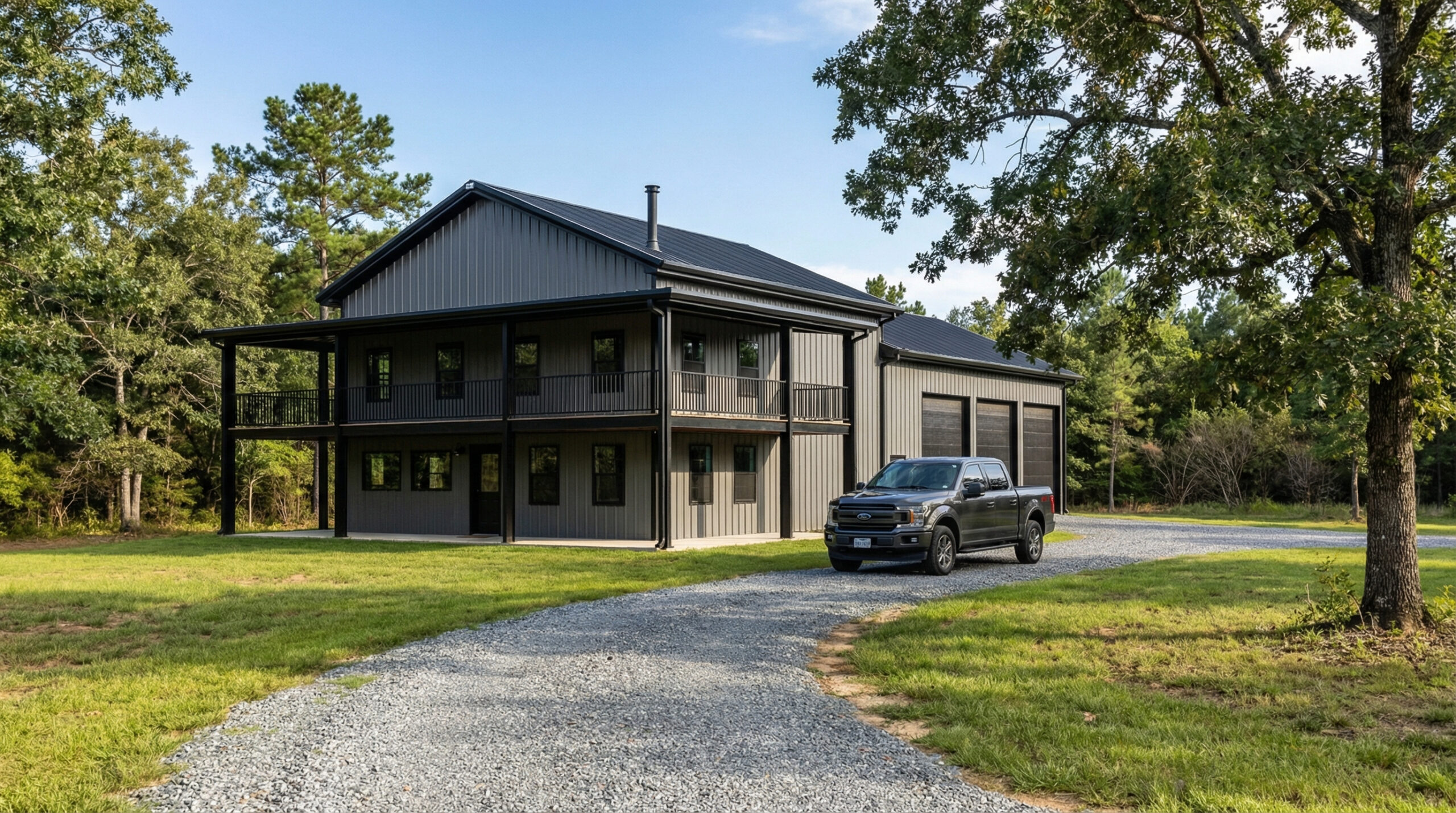
If you own land in Texas—or plan to—you’re probably asking yourself this question: How do I actually pay for a barndominium?
Barndominium financing can be confusing because lenders sometimes don’t know how to classify it. But that’s half the problem. The building type isn’t the issue. The problem is in how it’s presented.
Let me explain.
Lenders evaluate risk through clarity. When a project is well-defined, barndominium financing moves faster. When it isn’t, you get rejection letters and wasted months.
Here’s what nobody tells you upfront: Texas banks and credit unions will finance barndominiums. They do it every day.
But they won’t finance vague plans, undocumented budgets, or projects without qualified builders. The loan itself isn’t special. The preparation is.
This guide walks you through barndominium financing the way it actually works in Texas. No wishful thinking. No glossing over the hard parts. Just the loan paths lenders approve, the documentation that matters, and the mistakes that kill deals before they start.
Table of Contents
Here’s Why Most People Struggle With Barndominium Financing
The challenge isn’t finding a lender. Texas has dozens of banks, credit unions, and Farm Credit associations that finance barndominiums regularly.
The challenge is that barndominiums don’t fit neatly into traditional lending categories.
Your local bank has a process for conventional homes. They have comparable sales data. They have appraisers who know exactly what a three-bedroom ranch in your zip code should cost. That system works because everyone speaks the same language.
Barndominiums break that system.
Your project might be a 2,400-square-foot steel-frame home with spray foam insulation and a chef’s kitchen. Or it might be a 40×60 metal shell with a bathroom and mini-split. Lenders can’t evaluate what they can’t categorize.
The fix isn’t finding a special “barndominium loan.” The fix is presenting your project so clearly that lenders can evaluate it like any other construction loan.
The Loan Paths That Actually Work for Barndominium Financing
Texas landowners have several proven paths to barndominium financing. Each has trade-offs. None is universally “best.” The right choice depends on your land situation, income structure, and how much flexibility you need.
Construction-to-Permanent Loans: The Standard Path
This is how most Texas barndominiums get financed.
One loan closes before construction. Funds release in stages as work progresses. When the home is complete, the construction loan converts to a permanent mortgage. You avoid multiple closings. You lock your rate early. You gain predictability.
Texas Farm Credit offers one-time close construction loans specifically for barndominiums, with fixed rates and terms up to 30 years. Rural 1st, part of the Farm Credit system, finances barndominium construction the same way they finance conventional homes—no higher rates, no larger down payments, no shortened terms.
Most construction-to-permanent loans require 10-20% down. You’ll need detailed plans, a qualified builder, and a realistic budget before approval.
USDA Construction Loans: Zero Down in Rural Areas
If your land is in a USDA-eligible rural area—and most of East Texas qualifies—this program deserves serious consideration.
USDA construction loans offer 100% financing. No down payment required. The loan covers land, construction, and permanent financing in a single closing. Interest rates are competitive because the federal government backs the loan.
The catch: strict requirements.
Your barndominium must be your primary residence. It must sit on a permanent foundation. It must meet all USDA property standards and local building codes. The structure must function as a home—not a shop with a bedroom attached.
Income limits apply. For most Texas counties, household income must fall below 115% of the area median income. A family of four in Henderson County, for example, can earn up to approximately $110,650 annually and still qualify.
Check your specific location and income eligibility at the USDA’s property eligibility map.
Not every lender offers USDA construction loans for barndominiums. You’ll need to find one that does—and that understands how to navigate appraisals for non-traditional structures.
VA Loans: Possible but Complicated
Veterans can technically use VA loans for barndominium construction. The benefits are significant: 100% financing, no private mortgage insurance, competitive rates.
The reality is more difficult.
VA construction loans are already rare. Most lenders don’t offer them. Add the complexity of a non-traditional structure, and your options narrow further.
The bigger hurdle is appraisals. VA loans require appraisals based on comparable sales. If there aren’t three similar properties that have sold recently in your area, the appraiser can’t establish value. No established value means no loan approval.
This doesn’t mean VA barndominium financing is impossible. It means you’ll need a lender experienced with both VA construction loans and non-traditional properties—and you’ll need to build in an area with enough comparable sales to support an appraisal.
Farm Credit and Portfolio Lenders: Local Knowledge Matters
Farm Credit associations across Texas specialize in rural lending. They understand land values, agricultural properties, and construction in areas where national banks won’t lend.
Legacy Ag Credit in Northeast Texas offers barndominium construction loans with personalized terms. Texas Farm Credit covers the state with rural home loans, construction financing, and conventional mortgages for barndominiums.
Portfolio lenders—banks that keep loans on their own books rather than selling them—can offer flexibility that larger institutions can’t. They evaluate each deal individually. If your income is complex, your timeline is tight, or your project doesn’t fit traditional underwriting, a portfolio lender might say yes when others won’t.
The trade-off: rates and terms vary widely. You’ll need to shop around and compare offers.
Local Texas Banks and Credit Unions
Don’t overlook community banks. Many have financed barndominiums for years without advertising it.
We regularly work with lenders who understand rural construction in East Texas.
Blake Garner and Tracy Jock at Community National Bank & Trust of Texas are part of that group.
Community National Bank & Trust of Texas serves multiple East Texas communities, with branches across the region and local underwriting teams that understand rural construction.
Whether you’re building in Navarro County, Henderson County, Anderson County, or surrounding areas, Blake, Tracy, and the team at Community National Bank & Trust of Texas can structure construction-to-permanent loans for both residential and complex commercial builds.
They’ve seen barndominiums. They understand draw schedules. They know how to structure land equity into down payments.
That local familiarity matters.
Community banks often move faster because decisions are made locally. Underwriters know the counties. Appraisers know the product type. Questions get answered directly.
When your lender understands what you’re building, momentum follows.
Southside Bank, Texas Bank and Trust, and Austin Bank also operate across East Texas and understand rural construction lending. Community Resource Credit Union is another local lender that specifically offers barndominium financing on its website.
The advantage of local lenders: they know the market. They’ve seen barndominiums sell. They have relationships with local appraisers who understand how to value non-traditional structures.
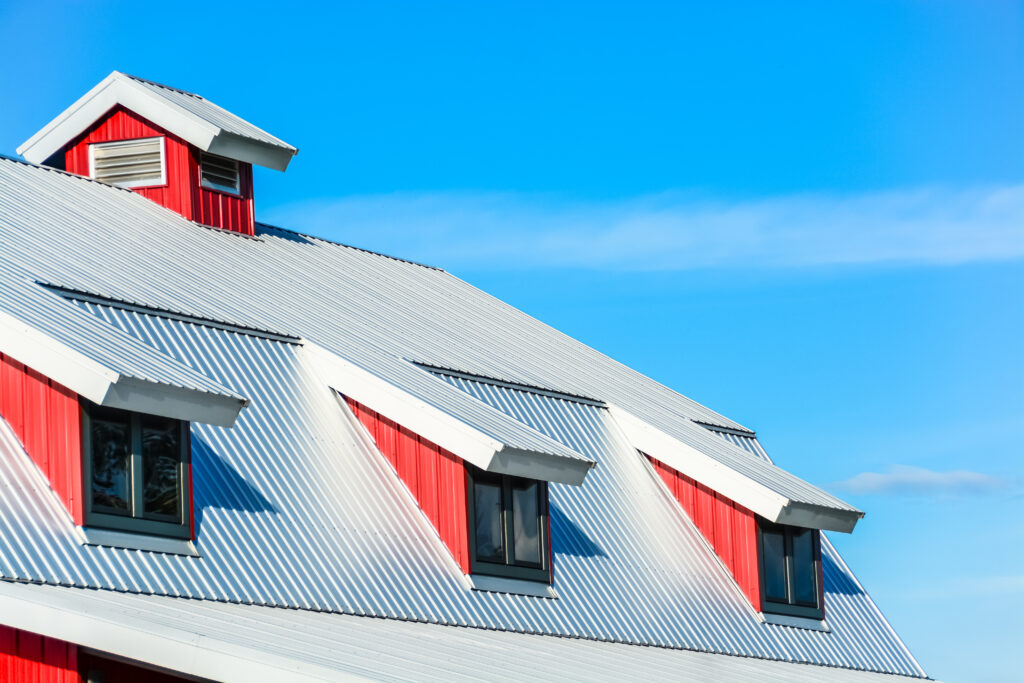
The Appraisal Problem Nobody Mentions
Here’s where barndominium financing gets complicated.
Before any lender approves a construction loan, they need to know what the finished property will be worth. That requires an appraisal. Appraisals depend on comparable sales—recent sales of similar properties in your area.
Traditional homes have plenty of comps. Appraisers can find dozens of three-bedroom houses that sold within a few miles in the past six months. Valuation is straightforward.
Barndominiums rarely have comparable sales nearby.
Your appraiser might need to search a wider geographic area. They might need to adjust values for different construction types. They might need to use comparable sales from months or even years ago.
This creates uncertainty. And lenders hate uncertainty.
…lenders hate uncertainty.
The practical impact: your barndominium might appraise lower than its actual construction cost. If that happens, you’ll need a larger down payment to cover the gap—or you’ll need to find a different lender with more flexible guidelines.
There’s good news. As more barndominiums are built and sold across Texas, appraisers have more data to work with. The appraisal problem is getting easier, not harder.
Here’s what you can do:
- Build in an area where barndominiums have already sold.
- Choose a design that looks residential rather than agricultural.
- Work with an experienced builder whose projects appraise well.
- Document everything—
- detailed plans,
- quality finishes,
- professional construction
- —so the appraiser can justify the value.
What Lenders Actually Need for Barndominium Financing Approval
You don’t need finished plans to start conversations with lenders. But you do need structure.
Most barndominium financing requires:
- A defined construction budget with itemized costs
- Preliminary plans or detailed scope of work
- A draw schedule showing when funds will be needed
- Builder credentials, license, and insurance documentation
- Proof of land ownership or a purchase contract
- Your personal financial documentation: income verification, tax returns, and credit history
The more complete your documentation, the faster underwriting moves. Lenders ask follow-up questions when information is missing. Every question adds days or weeks to your timeline.
Projects with vague budgets, undefined allowances, and unclear responsibility lines stall in underwriting. Projects with detailed documentation close.
Why Defined Scope Speeds Up Barndominium Financing
Underwriters dislike guesswork.
When your budget says “flooring: $15,000 allowance” without specifying what flooring you’re actually installing, that’s a red flag. When your plans show “kitchen” without specifying cabinets, countertops, and appliances, that’s another red flag.
Each undefined element creates a question. Each question requires follow-up. Each follow-up delays your closing.
Successful barndominium financing happens when owners make decisions early:
- What finish level are you actually building?
- What specific materials are included in each allowance?
- What happens when costs exceed allowances?
- Who is responsible for change orders and how are they approved?
When those answers are documented before you apply, approvals tend to follow.
The Pre-Construction Phase: Your Best Protection
Pre-construction is where estimates become dependable.
Before permits. Before material orders. Before ground breaks. This phase refines your scope, tightens your pricing, and aligns your builder, engineer, and lender around the same set of documents.
Good pre-construction creates:
- Detailed plans that meet lender requirements
- Itemized budgets tied to actual bids—not estimates
- Draw schedules that match construction phases
- Engineering documentation that satisfies local codes
- A complete scope of work that eliminates ambiguity
This costs money upfront. It takes time. Most builders skip it because they’re eager to start construction.
But pre-construction is where barndominium financing succeeds or fails. The investment in clarity pays for itself in smoother underwriting, fewer change orders, and a budget that doesn’t blow up mid-build.
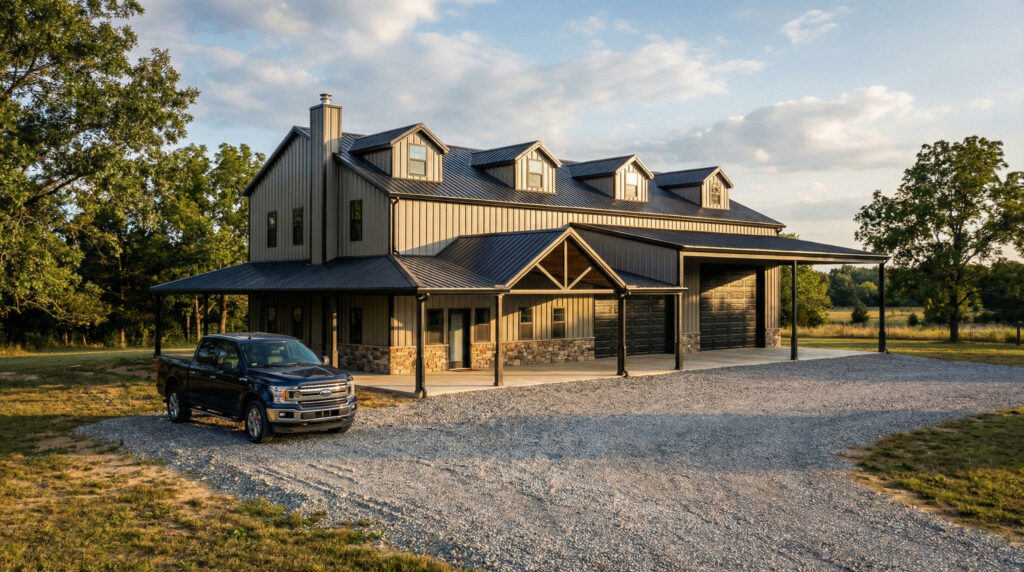
Common Barndominium Financing Mistakes to Avoid
These mistakes kill deals:
Vague budgets. “About $300,000” isn’t a budget. Itemized costs by category with documented sources is a budget.
Undefined allowances. A $10,000 cabinet allowance means nothing if you actually want $25,000 cabinets.
No qualified builder. Most Texas banks require a licensed, insured builder for construction loans. Owner-builder financing exists but is much harder to find.
Late design changes. Changing your floor plan after loan approval triggers re-underwriting. That costs time and sometimes kills the deal entirely.
Unrealistic timelines. Construction loans have draw schedules. If your builder can’t hit milestones, draws get delayed, and cash flow problems cascade.
Ignoring insurance requirements. Barndominiums sometimes fall into coverage gaps. Some carriers treat them as residential; others treat them as agricultural or commercial. Secure coverage commitments before you close.
Managing Draws in Barndominium Financing
Construction loans release money in phases. These draws typically follow:
- Design deposit
- Material deposit
- Foundation complete
- Framing and shell complete
- Mechanical systems (HVAC, electrical, plumbing)
- Interior finishes
- Final completion
Each draw requires inspection. The lender verifies that work is complete before releasing funds.
Accurate budgets aligned to these draws keep cash flow steady. If your foundation costs more than the foundation draw allows, you’re covering the difference out of pocket. If your shell comes in under budget but your interior finishes cost more than planned, you need the flexibility to reallocate.
Poor alignment between budget and draws causes delays, cash crunches, and friction with your builder.
FHA, USDA, and Other Government-Backed Barndominium Financing Options
Beyond USDA and VA, other government-backed programs may apply to barndominium financing.
FHA loans offer low down payments and flexible credit requirements. Some FHA-approved lenders will finance barndominiums if the structure meets FHA property standards. The barndominium must be primarily residential, on a permanent foundation, and built to local codes.
USDA Guaranteed Rural Housing loans work for existing barndominiums in eligible areas. The same income and property requirements apply as USDA construction loans.
Each program has rules. Each requires documentation. The takeaway: these programs can support barndominium financing, but preparation matters even more because government-backed loans have stricter property requirements.
Why Residential Standards Matter for Barndominium Financing
A barndominium must function as a home—not a shop with bedrooms.
Lenders look for:
- Proper insulation throughout the living space
- Residential-grade plumbing and electrical systems
- Permanent foundation (no skids or temporary supports)
- Code-compliant construction
- Adequate heating and cooling
- Safe water and wastewater systems
If your barndominium looks like a warehouse inside, lenders will hesitate. If it looks like a home—finished walls, quality fixtures, residential layout—financing follows standard paths.
This doesn’t mean you can’t have a workshop attached. It means the residential portion must clearly function as a residence.
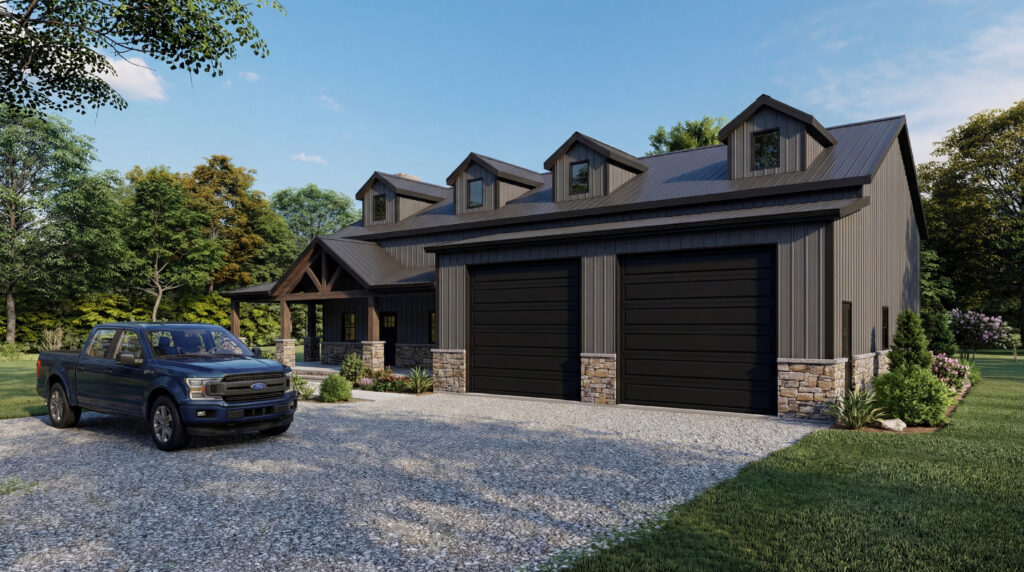
Your Land Equity: A Powerful Tool for Barndominium Financing
If you already own land, you have an advantage.
Many construction loans allow land equity to count toward your down payment. If your land is worth $100,000 and you’re building a $300,000 home, that $100,000 in equity might satisfy the lender’s down payment requirement entirely.
This matters because:
You keep more cash available for other expenses
You reduce out-of-pocket costs at closing
You may qualify for a larger loan amount
Land equity works differently for each lender. Some require the land to be paid off. Others will pay off an existing land loan as part of the construction loan. Some count full appraised value; others use a percentage.
Clarify how your lender treats land equity early in the process.
The Bottom Line on Barndominium Financing in Texas
Barndominium financing succeeds when preparation leads.
Defined scope. Clear budgets. Early coordination. Qualified builders. Complete documentation.
Those steps don’t just help lenders say yes. They help you build with confidence.
The loan isn’t the hard part. The clarity is.
If you want momentum instead of friction, preparation is your strongest asset. Texas has lenders who understand barndominiums. The question is whether you can present your project clearly enough for them to say yes.
Frequently Asked Questions About Barndominium Financing
Is barndominium financing more difficult than traditional home loans?
Not necessarily. With proper documentation and a qualified builder, barndominium financing follows similar paths as any construction loan. The extra complexity comes from appraisals—finding comparable sales for a non-traditional structure takes more work.
Do I need to own land before applying for barndominium financing?
Not always. Many construction loans combine land purchase and construction financing. However, owning land can strengthen your application by providing equity toward your down payment.
Can I act as my own builder for barndominium financing?
Some lenders allow owner-builders, but most prefer licensed contractors. Your options are significantly more limited without a qualified builder.
Are steel-frame homes appraised differently than stick-built homes?
They’re appraised as residential homes when they meet residential standards. The challenge is finding comparable sales—not the construction type itself.
What credit score do I need for barndominium financing?
Requirements vary by lender and loan type. Most conventional construction loans require 620-680 minimum. USDA loans typically require 640 for automated approval, though some lenders accept lower scores with compensating factors.
How long does barndominium financing take to close?
Typical timelines run 30-60 days for construction loans with complete documentation. Incomplete applications or appraisal delays can extend this significantly.
Can barndominium financing include land purchase?
Yes. Many construction-to-permanent loans combine land acquisition and construction in a single loan. This reduces closing costs and simplifies the process.
Ready to Talk About Your Barndominium Project?
We’ve helped landowners across East Texas navigate barndominium financing from the first conversation to the final walk-through.
We make things easy by:
- Making sure your project is documented,
- Budgeted, and
- Structured the way lenders need to see it.
Clear scope. Locked pricing. No surprises mid-build.
If you’re serious about building a custom steel-frame home or barndominium on your land, let’s talk. We’ll walk through your vision, your land, and your budget—and tell you exactly what it takes to make it real.
No pressure. No obligation. Just a conversation about what’s possible.


