

Pre-construction is where everything either comes together — or starts to fall apart.
It happens before a single beam goes up. Before a permit gets pulled. Before a contract gets signed. Pre-construction is the systematic process of aligning your vision, your site, your budget, and the physical reality of building — so none of those things surprise you halfway through.
If you’re planning a steel-frame home, a barndominium, or any pre-engineered metal building, this is the most important thing you’ll read before you make a single decision.
We’re going to explain exactly what pre-construction is, what it costs, what it prevents, and why skipping it is the most expensive mistake you can make.
Table of Contents
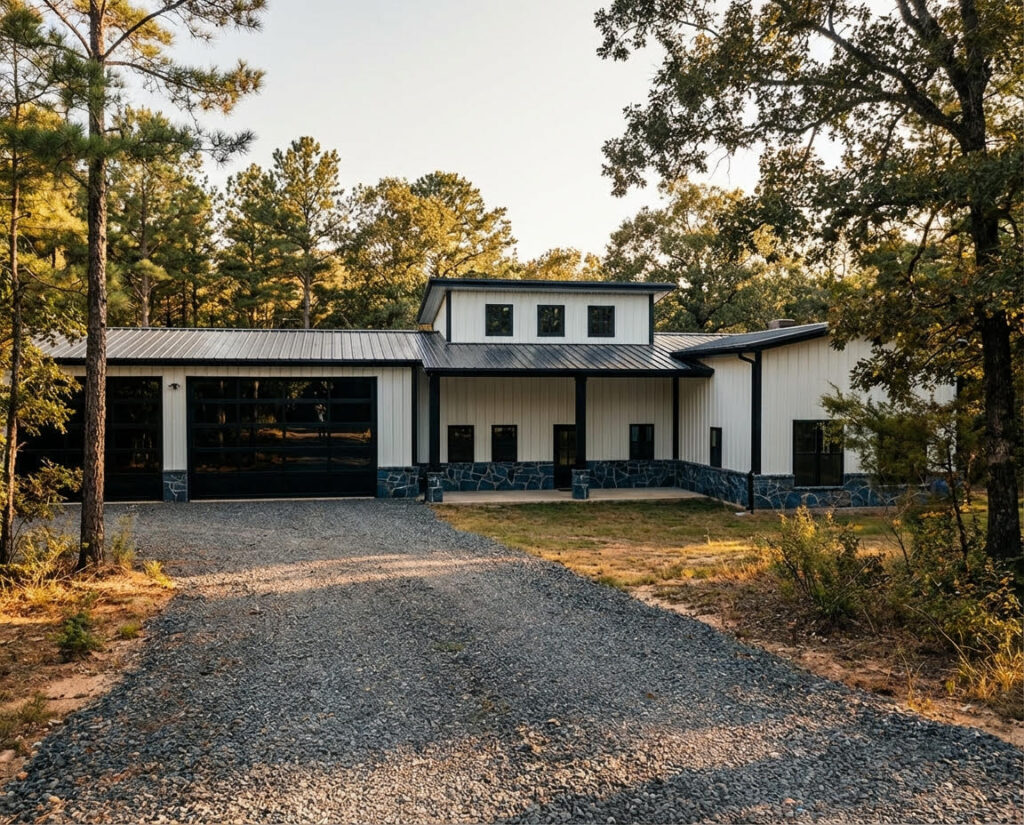
What Pre-Construction Really Is — and Why It Matters
Pre-construction is not a planning meeting. It’s not a deposit to hold your spot.
It’s a structured, phased process that answers the hardest questions before construction makes them impossible to answer cheaply.
- Can this design actually be built on this site?
- Does the budget match the vision?
- What does the soil say about the foundation?
- What permits will be required — and how long will they take?
Every one of those questions is easier and cheaper to answer in pre-construction than during construction. That’s the whole point.
Pre-construction covers six core disciplines:
- Design development — turning your vision into buildable drawings
- Budget forecasting — real numbers based on real inputs
- Engineering coordination — structural logic baked in from the start
- Site evaluation — understanding what your land will and won’t allow
- Permitting pathway — knowing what’s required before you submit
- Go/no-go validation — a formal checkpoint before real money moves
Together, they form a filter — not a fee grab. They prevent misalignment, eliminate costly surprises, and make sure you’re not pouring money into a design that was never viable to begin with.
What Pre-Construction Costs — and What Skipping It Costs More
A thorough pre-construction process typically runs between 7% and 15% of the total projected build cost.
- On a $600,000 barndominium: $42,000 to $90,000
- On a $1.2M custom steel frame home: $84,000 to $180,000
That sounds like a lot to spend before anything gets built.
Here’s the comparison that reframes it. The average American pays 5% to 6% in real estate commission when selling an existing home. On a $600,000 home, that’s $30,000 to $36,000 — paid to transfer a structure someone else built. Nobody questions it.
And yet those same buyers balk at spending a similar percentage to protect a custom design-build investment that’s twice the size, built to their exact specifications, on their own land.
The math doesn’t hold. The psychology does — because commission feels normal and pre-construction feels optional.
It isn’t.
The Construction Industry Institute has found that every dollar spent in pre-construction saves between $3 and $10 in construction-phase costs. The National Association of Home Builders consistently identifies budget overruns as one of the top sources of homeowner dissatisfaction in custom construction. The data points in one direction, every time.
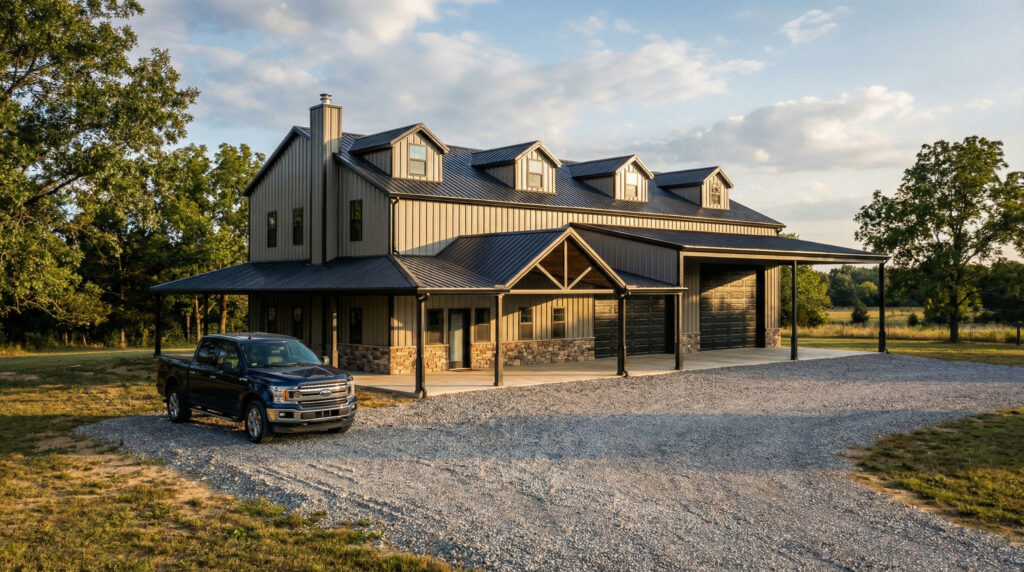
Steel Frame Homes, Barndominiums, and PEMBs: One Pre-Construction Principle
The internet uses these terms interchangeably. It shouldn’t. Let’s be clear about what each one is — and why pre-construction matters for all three.
Steel Frame Homes Fully custom-designed residential structures built on a structural steel skeleton. Every beam, column, and connection is engineered specifically for that home on that site. No catalog. No standard dimensions. These are design-build projects driven by architects and licensed structural engineers.
Barndominiums Hybrid structures — typically a large open metal shell purpose-built as a living space. They range from modest rural retreats to high-end custom residences with soaring ceilings and open-concept great rooms spanning 60 to 80 feet without a load-bearing wall. At the high end, indistinguishable from a custom home. At the low end, a pole barn with plumbing.
Pre-Engineered Metal Buildings (PEMBs) Manufactured structural systems — rigid steel frames engineered to standard load tables by the manufacturer, sold as kits, erected on site. Companies like MBCI, NCI Building Systems, and Nucor Building Systems dominate this market. Fast, economical, highly functional. Used for warehouses, flex-space, agricultural storage, and small-bay industrial. Not typically custom-designed.
Why pre-construction matters for all three:
The risks are different. The need for pre-construction is identical.
- A custom steel frame home needs pre-construction because every design decision has structural and cost consequences that don’t surface until engineering is done
- A barndominium needs pre-construction because “barndominium” can mean anything from $80 to $300 per square foot depending on finish level, structural system, and site conditions
- A PEMB needs pre-construction because the manufacturer’s kit quote doesn’t include the foundation, site work, utilities, mechanical systems, insulation, or interior finish — which can easily double the cost of the kit itself
Same principle. Different failure modes. One solution.
Why So Many Projects Go Sideways Before Ground Is Broken
Here’s what typically happens.
A couple buys land. They’ve been watching barndominium builds on YouTube for a year. They find a floor plan online — 2,800 square feet, open concept, big shop, wraparound porch. The plan costs $149.99. The website says builds like this run $120 to $150 per square foot. They do the math. They call a builder.
The builder asks about the soil report.
They don’t have one.
The builder drives out. The land is beautiful. It’s also:
- On a slope requiring $30,000 in grading and possibly a retaining wall
- Without a driveway or any kind of drainage plan
- A quarter-mile from the nearest electric service
The project isn’t $120 to $150 per square foot anymore. It’s $195. And they’ve already told their family they’re moving in by Christmas.
This is not a rare story. In our experience, it’s the default story when pre-construction is skipped.
Pre-construction closes that gap. Every time.
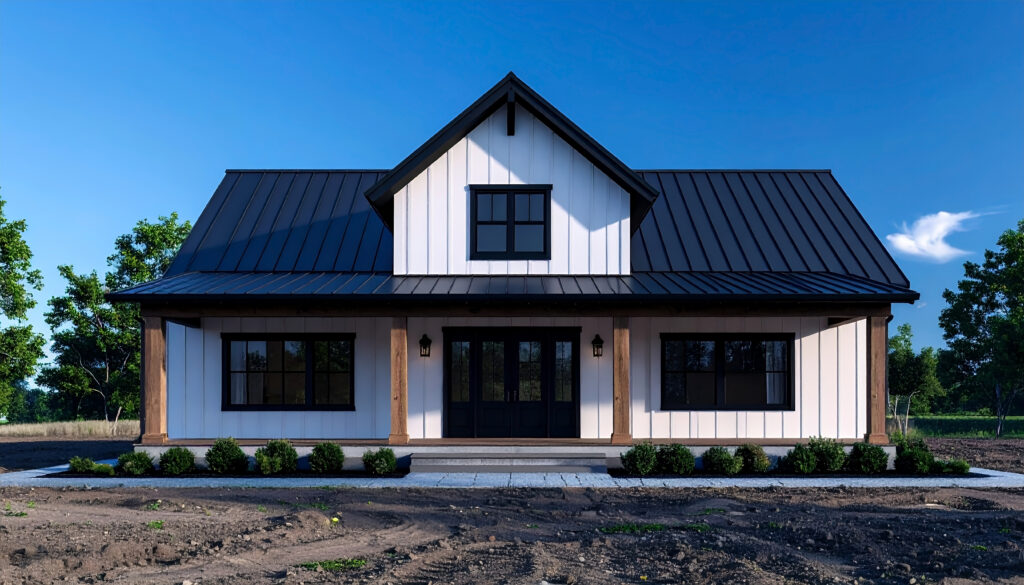
What Pre-Construction Does for Your Site
No variable in a construction project is less visible — and more consequential — than the site.
The land looks flat, but the survey reveals a 6% grade, requiring a crawl space rather than a slab. The soil looks firm until the geotechnical report comes back with expansive clay at 18 inches, requiring engineered piers at $2,500 each. The well driller hits rock at 180 feet instead of 80.
These aren’t horror stories. They’re the typical realities many hopeful homeowners face.
A serious pre-construction process addresses site conditions before they become budget surprises. Here’s what that looks like:
Topographic Survey
Establishes existing grades, drainage patterns, and buildable area. Essential for foundation design, driveway grades, and stormwater management.
- Cost: $1,500 to $5,000 depending on acreage and terrain
- Resource: Texas Society of Professional Surveyors
Geotechnical Report
This document tells your structural engineer what foundation your site actually needs. Without it, any foundation design is a guess. With expansive soils — common across Texas, the Gulf Coast, and the Plains states — the wrong foundation can result in structural movement that triggers six-figure remediation.
- Standards published by the American Society of Civil Engineers
- Non-negotiable before foundation design begins
Utility Assessment
Every one of these has a cost range that must be established before budgeting:
- Electric service: How far is it? What’s the extension cost?
- Gas: Natural gas available, or propane?
- Water: Municipal connection or well?
- Sewer: Municipal or septic?
- A rural build without utilities at the road can add $30,000 to $100,000+ before a beam goes up
Floodplain and Zoning Verification
- Check flood status at the FEMA Flood Map Service Center
- Verify setbacks, deed restrictions, and HOA rules
- Confirm the structure you want to build can be built where you want to put it
- Many Texas counties have adopted minimum building standards — pre-construction verifies compliance before design is locked
Every one of these items affects your design, your budget, or both. None of them appears in a floor plan you bought online.
Pre-Construction and Engineering: Why Steel Rewards Good Planning
Every permitted structure in the United States requires engineering. Wood frame, concrete, masonry — all of it. The difference with steel isn’t that it requires more paperwork. It’s that steel’s engineering precision creates opportunities that other materials simply can’t match.
Clear spans of 60 to 80 feet with no load-bearing walls. Column-free interiors. Exact point loads that eliminate structural guesswork. These aren’t limitations of steel — they’re the reasons people choose it.
What steel does require is that you respect the precision it’s built on. A wood frame house can absorb a lot of field improvisation. Steel doesn’t forgive sloppy planning the same way. Get the engineering right in pre-construction, and steel delivers on every promise. Skip it, and you’ll pay to fix decisions that should have been made at a desk, not on a job site.
For steel frame structures specifically, early pre-construction engineering catches issues that don’t exist in wood frame construction:
Clear Span Loads
A 60-foot clear span in a barndominium great room is achievable. The beam depths, column sizes, and connection details required to get there have real cost implications. An engineer in the room during design keeps those visible. An engineer brought in after the fact finds them after the design is already committed.
Wind and Seismic Loads
Much of Texas falls in high-wind design territory. The American Society of Civil Engineers ASCE 7 establishes the load standards engineers work from. Pre-construction engineering confirms your design meets local requirements before the permit reviewer does it for you — expensively.
Foundation Design
Steel buildings exert point loads at the column bases rather than the distributed loads of wood-frame construction. The foundation must be designed for those loads without differential settlement. This requires the geotechnical report. A foundation designed without one is an engineer’s liability — and, practically speaking, the owner’s problem.
MEP Coordination
Mechanical, electrical, and plumbing systems in a steel structure run through and around structural members, requiring coordination during design. HVAC ductwork in a barndominium with 16-foot ceilings and exposed steel purlins is a design challenge — not an afterthought. Addressing it in pre-construction prevents expensive field modifications.
The American Institute of Architects has published extensively on how early integration of engineering reduces downstream change orders and cost overruns.
The conclusion is consistent: the earlier you bring engineering into the process, the less it costs overall.
Pre-Construction Budgeting: Real Numbers vs. Wishful Thinking
The most dangerous number in a construction project is the one that sounds right before any real work has been done.
Online calculators, ballpark estimates from builders who haven’t seen your site, and cost-per-square-foot figures on floor plan websites are all the same thing in different clothes: guesses.
Useful for rough orientation. Dangerous as planning tools.
A pre-construction budget is built on real inputs:
Design Development Drawings
Not a sketch. A dimensioned set of drawings that tells an estimator exactly what needs to be built — room by room, system by system.
A Complete Finish Schedule
Finish level is the single biggest driver of per-square-foot cost variability. A barndominium with builder-grade finishes might cost $140 per square foot. The same floor plan with luxury finishes might cost $240. Without a locked finish schedule, a budget is fiction.
Examples of finish decisions that move the number significantly:
- Luxury vinyl plank vs. hand-scraped hardwood
- Builder-grade windows vs. thermally broken commercial aluminum
- Basic HVAC vs. high-efficiency zoned system
- Standard countertops vs. full-slab natural stone
Real Trade Partner Input
A builder with real subcontractor relationships can get actual bids during pre-construction — not published rates, not national averages. What it costs to hire a qualified electrician in your county, in this market, for this specific scope of work.
Current Material Pricing
Steel prices fluctuate. Concrete fluctuates. A budget built on steel prices from six months ago may be off by 10% to 15% on that line item alone. Pre-construction that includes active procurement outreach catches those movements before the construction contract is signed.
Long-Lead Item Identification
These lead times are real, and they will stall your project if nobody planned for them:
- Structural steel fabrication: 10 to 20 weeks
- Large custom windows: 12 to 16 weeks
- HVAC equipment: 8 to 14 weeks in recent markets
Identifying these in pre-construction and placing conditional holds with suppliers keeps the schedule from stalling on material nobody ordered.
At Trinity Metalworks, our five-phase Integrated Project Delivery process targets budget accuracy within 5% of the final project cost by the time a construction contract is signed. Not a guess with a contingency attached. A number backed by engineering, real trade bids, and a complete scope of work.
Pre-Construction and Permitting: The Timeline Nobody Plans For
Permitting is the most underestimated variable in any construction timeline.
- Rural Texas county with minimal regulation: 2 to 4 weeks
- City with full plan review — energy code, structural adequacy, fire separation: 4 to 6 months
That’s assuming the plans are right the first time.
Pre-construction addresses permitting three ways:
Jurisdictional Research
Before design is finalized, pre-construction identifies:
- Which jurisdiction has authority over the project
- Which code editions are adopted (Texas has adopted the 2021 International Building Code in many jurisdictions, but adoption varies by municipality and county)
- What the specific submittal requirements are
Knowing this before design is complete lets the team build compliance in — not revise it in after the fact.
Complete Plan Preparation
A permit-ready set typically includes:
- Structural engineering calculations
- Geotechnical report
- Site plan with drainage and grading
- Foundation design
- Energy compliance report per IECC 2021
- MEP schematics
- Completed application package
Assembling it correctly the first time eliminates back-and-forth with the building department. The Texas Department of Licensing and Regulation governs contractor licensing requirements that affect who can pull permits for what types of work — another item pre-construction verifies in advance.
Timeline Integration
A builder who submits for permits during pre-construction — before the construction contract is signed — can have permits in hand when mobilization begins. This compression of the critical path is one of the most tangible schedule benefits of a serious pre-construction process.
Value Engineering: How Pre-Construction Pays for Itself
Value engineering, done right, means finding a different way to achieve the same outcome at lower cost — without sacrificing what the owner actually cares about.
Pre-construction is when value engineering is possible. Construction is when it becomes a change order.
Here’s what value engineering looks like in practice:
Structural Bay Optimization
In a steel structure, column spacing determines how much steel is required. There is usually an optimal bay spacing that minimizes structural cost for a given footprint. Finding it requires an engineer doing the math during pre-construction — not after fabrication drawings have been released.
Foundation Type Selection
The cost difference between foundation types on a typical residential project:
- Monolithic slab vs. post-tension slab vs. pier-and-beam: $15,000 to $80,000 difference
- Pre-construction evaluation identifies which type is appropriate for your soil conditions and structural loads
- Sometimes reveals that a less expensive option is structurally adequate
Phasing Strategy
Many barndominium and commercial projects can be built in phases:
- Owner occupies and uses the structure sooner
- Cost deferred without function deferred
- Phase boundaries identified in pre-construction cost far less than retrofitting a phasing strategy after construction has begun
Envelope Decisions
Standing-seam metal roofing, exposed-fastener metal panels, insulated metal panels, and conventional systems all have different costs and performance profiles. Making this decision during pre-construction — with accurate cost inputs — prevents the common mistake of speccing one system and building another because the original choice was over budget.
The Problem with Online Floor Plans and Kit Pricing
The internet is full of beautiful barndominium floor plans for $500 to $2,000. They look ready to build. The websites publish price-per-square-foot estimates that make the project look affordable.
Most of those plans are not build-ready. The pricing is not accurate.
Here’s what a purchased floor plan typically doesn’t include:
- Site-specific engineering
- Regional wind and load calculations
- A foundation design
- Utility connections
- MEP coordination
- Permit-ready documentation
- Current material pricing
- Any input from a builder who knows what it costs to build in your county
The plan is a starting point. Inspiring, useful, and completely insufficient as a budget or a build document.
The same problem applies to PEMB kit pricing. A manufacturer’s quote for a 5,000-square-foot commercial metal building might be $85,000. Here’s what that number doesn’t include:
| Item | Typical Cost Range |
|---|---|
| Foundation | $40,000 – $80,000 |
| Site work | $20,000 – $60,000 |
| Erection labor | $25,000 – $50,000 |
| Insulation | $15,000 – $30,000 |
| Interior framing and finish | $40,000 – $120,000 |
| Mechanical and electrical | $30,000 – $80,000 |
| Permits and engineering | $8,000 – $20,000 |
The kit is the structure. The building is everything else. Pre-construction makes everything else visible before you’ve committed to it.

How Trinity’s Five-Phase IPD System Approaches Pre-Construction
At Trinity Metalworks, pre-construction isn’t a phase we offer. It’s a system we’ve built our entire process around. We call it Integrated Project Delivery — five stages, zero surprises.
Phase 0 — Project Discovery Free initial consultation. We listen first. We establish your vision, your site, your preliminary budget, and your timeline. No commitment beyond the conversation.
Phase 1 — Pre-Construction Investigation Where the real work begins:
- Site assessment and feasibility analysis
- Preliminary design concepts
- Preliminary budget based on current market data
- Investment: $5,000 to $8,500 — applied toward your total project cost
Phase 2 — Precision Engineered Design
- Full design development and structural engineering
- MEP coordination
- Complete 3D model
- Detailed budget accurate to within 10% of final project cost
- Full permit set ready for submission
- Investment: $12,500 to $15,000 — applied toward your total
Phase 3 — Construction Deposit and Final Sign-Off
- Final design review
- Trade partner pricing confirmed
- Construction contract finalized to within 5% accuracy
- Your budget and timeline are locked before ground breaks
- No surprises. No scope creep.
Phases 4 and 5 — Construction and Completion
- We build what we engineered with you
- Progress billing tied to completed milestones
- Live project updates and daily logs
- White-glove project management from mobilization to keys in hand
The result: a build that looks like what you planned, costs what you budgeted, and finishes when we said it would.
FAQ: Frequently Asked Questions About Pre-Construction
What is pre-construction, and why do I need it?
Pre-construction is the planning phase before construction begins. It covers site evaluation, design development, engineering, budgeting, and permitting. You need it because every major construction decision is cheaper to make before construction starts than during it. Pre-construction turns your vision into a buildable, fundable plan with a locked budget.
How much does pre-construction cost?
Pre-construction typically runs 7% to 15% of the total projected build cost. In a well-structured system like Trinity’s IPD, that investment is applied toward your total project cost. It’s not an additional fee on top of the build.
Is pre-construction the same as a design consultation?
No. A design consultation addresses aesthetics and layout. Pre-construction addresses everything: design, engineering, site, budget, permits, and schedule. A design consultation is one input into pre-construction — not a substitute for it.
Can I skip pre-construction if I already have plans?
You can. People do it all the time. What typically follows:
– Structural revisions after engineering review
– Permit rejections requiring plan resubmission
– Budget overruns from undefined scope
– Change orders throughout construction
Purchased plans are a starting point. They don’t include site-specific engineering, current material pricing, or a permit-ready package for your jurisdiction.
What’s the difference between pre-construction for a barndominium versus a PEMB?
The principles are identical. The risk profile is different:
– Barndominiums carry finish-level variability risk — the cost range is wide and undefined until a finish schedule is locked
– PEMBs carry expectation risk — the kit price excludes most of the actual project cost
Pre-construction addresses both.
How long does pre-construction take?
For a typical residential project — a steel-frame home or barndominium — expect 6 to 12 weeks for the process to be completed. Factors that extend the timeline:
– Complex sites or unusual terrain
– Jurisdictions with longer permit review periods
– High design ambition requiring more engineering iterations
Rushing pre-construction to save time is one of the most reliable ways to lose time in construction.
Do I need a soil report before pre-construction begins?
You don’t need it before pre-construction begins — but you’ll need it during. A geotechnical report is essential for foundation design, and foundation design is essential for accurate budgeting. Without a soil report, any foundation cost estimate is a guess.
What is value engineering, and when does it happen?
Value engineering is finding a different way to achieve the same outcome at lower cost — without sacrificing what the owner cares about. It happens during pre-construction, when design is still flexible and changes are inexpensive. Once construction starts, value engineering becomes a change order.
Can pre-construction tell me if my budget is realistic?
That’s one of its primary functions. Pre-construction specifically answers the question: Does this vision fit this budget? If it doesn’t, you have options:
– Adjust the design
– Adjust the scope
– Phase the build
– Wait until your financial position changes
You find this out before signing a construction contract — not after.
What happens if pre-construction reveals my project isn’t feasible?
That’s the best possible outcome from a bad situation. Far better to find out before you’ve spent the real money. A good pre-construction process includes a formal go/no-go decision point. If the numbers don’t work, you can redesign, rescope, or simply wait. You don’t lose a construction budget finding out — you lose a pre-construction investment.
What is Integrated Project Delivery (IPD)?
IPD is a project delivery method that aligns the owner, designer, and builder into a single collaborative team from the beginning. Rather than design happening first, construction documents second, and the builder brought in to price finished plans — IPD brings all parties together early so buildability, budget, and design are developed simultaneously. The American Institute of Architects has published extensively on IPD principles and outcomes.
What should I bring to a pre-construction consultation?
Bring what you have:
– Land information — address or parcel number, any existing surveys
– Preliminary budget
– Timeline
– Design inspiration — floor plans, photos, renderings, anything
Don’t worry about having a polished vision. That’s what pre-construction is for.
Will pre-construction fees apply toward my construction cost?
At Trinity Metalworks, yes — pre-construction investment is applied toward your total project cost. This is the structure you should look for in any design-build partner. A builder who charges pre-construction fees that don’t apply toward construction is effectively charging you twice.
What’s the difference between a design-build firm and a general contractor for pre-construction?
– Design-build firm: Design, engineering, and construction under one roof. Pre-construction is seamless — the team that designs is the team that prices and builds
– Traditional GC model: You hire a separate architect and engineer, then bring in a GC to price finished plans. This creates opportunities for misalignment between what was designed and what can actually be built for the budget
Design-build compresses that gap at every stage.
Does pre-construction include permitting?
A thorough pre-construction process includes:
– Jurisdictional research
– FEMA Floodplain research
– Plan preparation to permit-ready standards
– Permit submission
In the best-structured systems, permits are submitted during pre-construction so they’re in hand — or at least in active review — when construction mobilization begins.
This alone can compress the construction timeline by weeks or months.
What is a finish schedule, and why does it matter in pre-construction?
A finish schedule is a room-by-room specification of every material and system in a building — flooring, countertops, cabinetry, windows, doors, roofing, siding, plumbing fixtures, lighting, HVAC. It matters because finish level is the single biggest driver of per-square-foot cost variability. Without a locked finish schedule, a budget is meaningless.
How does pre-construction affect my construction loan?
Construction lenders typically require:
– A set of plans
– A detailed budget
– A signed construction contract
A thorough pre-construction process produces all three, with documentation that makes lenders comfortable. A shaky budget built on ballpark estimates is a red flag. An engineered budget with trade bids behind it is not.
What is a go/no-go decision in pre-construction?
A formal checkpoint, typically at the end of Phase 1 or Phase 2, where the owner and builder review preliminary design, budget, and site findings and make a deliberate decision:
– Proceed to construction
– Redesign within budget constraints
– Rescope the project
– Stop
It’s one of the most valuable elements of structured pre-construction because it creates accountability and prevents momentum from carrying a project forward that shouldn’t go forward.
Is pre-construction required by law?
No. But engineering and permitted plans are required by law before construction begins in virtually every U.S. jurisdiction. Pre-construction is the process that produces those documents properly. Skipping pre-construction doesn’t eliminate the legal requirements — it just means you’ll produce them under pressure, on a shorter timeline, with less information. That combination reliably produces errors and delays.
What questions should I ask a builder about their pre-construction process?
Ask these specifically:
– What’s included in pre-construction?
– Do pre-construction fees apply toward construction?
– How is the preliminary budget built — what inputs does it use?
– Who does the engineering, and when are they brought in?
– Is there a formal go/no-go decision point?
– What happens to the work product if I choose not to proceed?
A builder who answers all of those clearly and confidently has a real pre-construction process. A builder who answers vaguely is winging it.
What’s the risk of using a pre-purchased floor plan as my starting point?
None — as a starting point. Significant risk if you treat it as a build document or a budget. Pre-purchased plans typically lack:
– Site-specific engineering
– Regional wind and load calculations
– A permit-ready documentation package
– Current material pricing
– MEP coordination
Bring the plan to pre-construction. Don’t skip pre-construction because you have the plan.
What does pre-construction look like for a commercial metal building project?
For commercial PEMBs and flex-space projects, pre-construction adds several layers not present in residential:
– Use classification — IBC occupancy classification affects structural, fire, and accessibility requirements
– ADA compliance — commercial structures must meet ADA Standards for Accessible Design
– Fire separation and egress — multi-tenant buildings have specific fire-rated assembly requirements
– Zoning and land use — commercial projects require verified zoning, sometimes conditional use permits
– Utility capacity — commercial electrical loads often require utility coordination before design is finalized
Pre-construction for commercial projects typically runs longer and costs more than residential, and saves proportionally more.
How does pre-construction affect the steel fabrication timeline?
Significantly. Structural steel fabrication requires engineered drawings before a fabricator can begin. Lead times run 10 to 20 weeks from order to delivery. A pre-construction process that completes structural engineering early and places conditional holds with fabricators can cut weeks — sometimes months — from the total project timeline. This is one of the clearest ROI cases for pre-construction, specifically in steel construction.
The Decision You Make Before the Decision
Building a custom steel frame home, a barndominium, or a commercial metal building is one of the most significant financial decisions most people will ever make.
Pre-construction is the decision that makes the next decision manageable.
It’s where you find out if your vision fits your budget. It’s where the site tells its story before it becomes a problem. It’s where the engineer catches the structural issue that would have cost $80,000 to fix mid-build. It’s where the permit reviewer’s questions get answered in the design — not in a revision cycle.
Every hour you invest in pre-construction saves many hours during construction. Every dollar you spend in pre-construction protects far more dollars downstream.
That’s not opinion. It’s the documented experience of every well-run construction project — and the hard lesson of every project that skipped it.
Ready to get started? Schedule your pre-construction consultation with Trinity Metalworks today.
Trinity Metalworks is a custom steel frame design-build firm headquartered in Kerens, Texas, serving the Waco-to-DFW corridor and East Texas. We specialize in custom steel frame homes, barndominiums, and commercial metal buildings — built right, from the first conversation to the last walk-through. build.


