
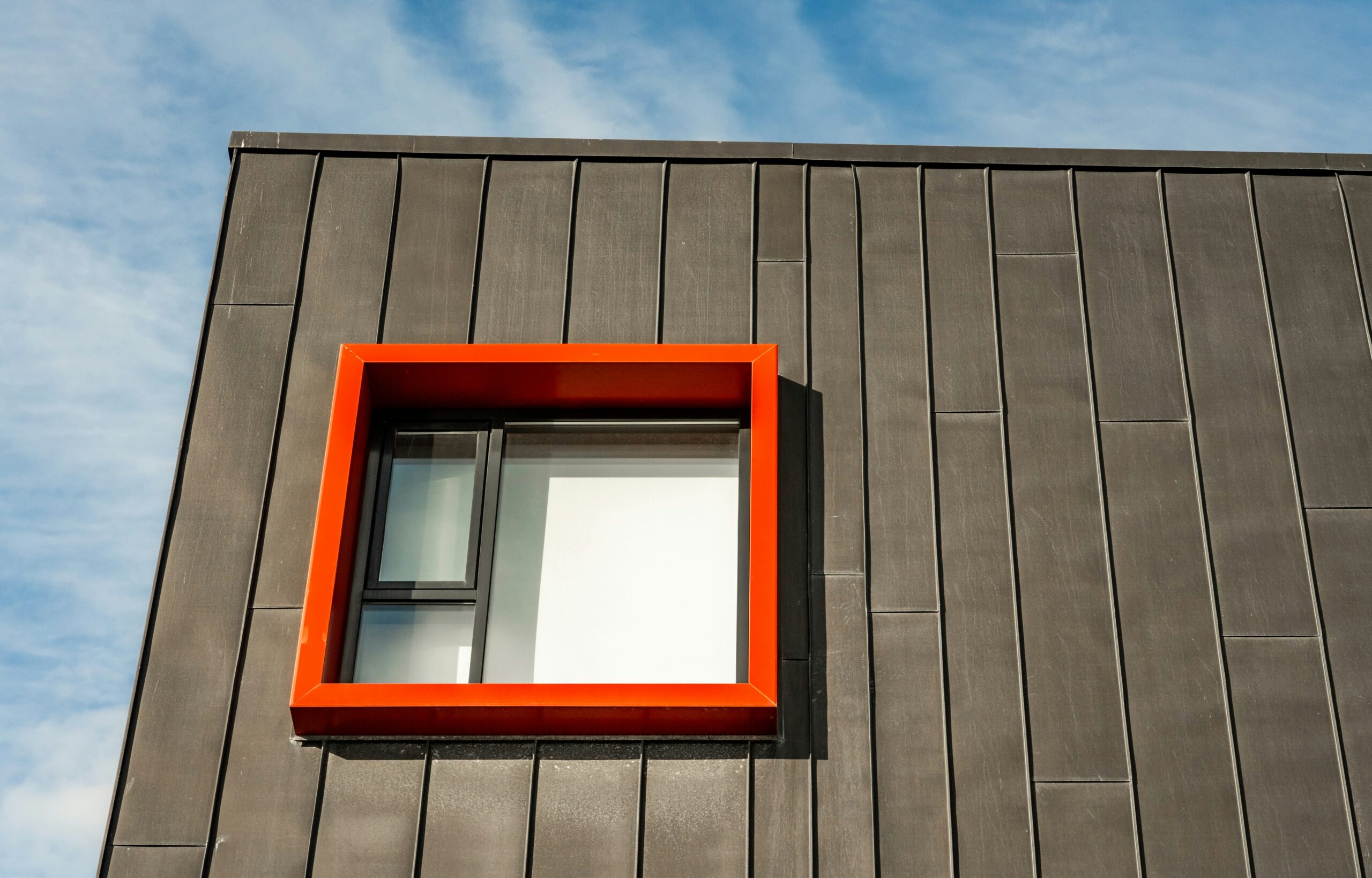
Have you ever heard of oil canning? Maybe you have, maybe not, but I bet you’d know it when you saw it.
Oil canning is that subtle waviness you see in flat metal panels. It shows up under certain light conditions — low-angle morning sun, late afternoon in November, the kind of light that rakes across a surface and finds every imperfection. It is not a structural defect. It is not a sign of inferior materials or bad workmanship. It is a physical property of thin-gauge steel, documented by every major industry standard, and excluded from virtually every manufacturer’s warranty — not because the warranty is weak, but because the effect doesn’t compromise your home in any way that matters.
What it can compromise is your peace of mind, if nobody prepared you for it.
This guide does that. We’ll explain what causes oil canning, how the Texas climate makes it more visible, what design and material choices reduce it, and how Trinity approaches it on every build.
Key Takeaways
- Oil canning is a cosmetic characteristic of light-gauge metal panels, not a structural defect.
- Texas heat and sun angle make the effect more visible — this is predictable and manageable.
- Gauge, profile, finish, and installation technique all affect how pronounced the effect is
- The right builder addresses these variables at the design stage, not after you move in.
What is oil canning, and why does it affect Texas metal homes?
You see it in the light. A ripple across a flat panel. A shadow where you expected a clean line.
This is oil canning. It’s an elastic buckling effect in the “web” of a metal panel — the broad, flat field between ribs or seams. It happens because cold-rolled steel carries internal stresses from the manufacturing process: coiling, forming, cutting. Those stresses don’t disappear. They redistribute. Under the right conditions, they become visible.
It’s most common in light-gauge metals — the same materials chosen for their sleek, minimal profile in standing seam roofing and contemporary wall systems. The thinner the panel, the more susceptible it is. That’s not a design flaw. It’s physics.
The Metal Construction Association formally recognizes oil canning as an inherent characteristic of light-gauge metal panels. No manufacturer warranty covers it as a defect, because it isn’t one. Your roof’s weather resistance, load capacity, and service life are unaffected. The only thing at stake is visual — and that’s manageable if you plan for it.
Why the Texas climate makes oil canning more visible
North and East Texas don’t get filtered light. We get high-contrast, high-intensity sun that finds every surface variation and sharpens it into a shadow line.
The angle matters most. In Corsicana, the low-angle light of early morning and late afternoon — especially in fall and winter, when the sun sits lower in the sky — rakes across panel surfaces and amplifies any waviness. The same panel that looks perfectly flat at noon can show visible distortion at 7 AM. The effect changes not just by season, but by the hour.
Finish choice compounds this. A high-gloss or semi-gloss coating — common with premium Kynar 500 systems in the 30 to 40 gloss unit range — reflects the sky like a mirror. Any surface variation becomes immediately apparent. A matte or low-gloss finish diffuses reflected light instead of focusing it. That diffusion alone can make oil canning effectively invisible to the naked eye under most conditions.
The Materials at Risk
No metal is entirely immune. The risk is a matter of material science and design engineering. Certain profiles and metals simply show the effect more readily.
- Steel & Galvalume: As the most common materials, 24-gauge and 26-gauge panels are frequent candidates, especially in wider profiles.
- Aluminum: With a higher coefficient of thermal expansion, aluminum panels expand and contract more with temperature changes, which can contribute to visible waviness.
- Copper & Zinc: These premium architectural metals are softer and more susceptible to damage, requiring expert installation to minimize the effects.
Panel design is a critical factor. Wider flat surfaces, particularly those exceeding 16 inches, provide more room for the metal to move. This makes them more prone to visible distortion than narrower profiles. In bespoke homes, this often influences the choice between standing-seam and exposed-fastener systems. Standing seam roofs, prized for their clean, modern lines, have large, flat pans that can display the effect. Exposed fastener panels, with their defined ribs every 9 to 12 inches, have inherent rigidity that breaks up flat surfaces, making any waviness far less perceptible.
The Anatomy of the Wave: Why Metal Panels Distort
The visual distortion known as oil canning is not a defect. It’s a result. An inherent characteristic of light-gauge cold-rolled metal. The subtle waves you see are born from a series of stresses introduced long before the panels ever reach your building site. Understanding these forces is the first step toward controlling them.
Production and Roll-Forming Stresses
Metal has a memory. The journey begins with a massive steel coil, cold-rolled under immense pressure at the mill. This process locks tension into the material’s very structure. The coil is then slit to width and roll-formed into its final panel profile. Each bend and cut introduces new, localized stresses. Even microscopic deviations can create problems:
- Camber: A slight curve along the length of a panel, a deviation from a perfectly straight line.
- Cross-Bow: A minimal arch across the width of the panel.
An imperfection of just 1/16th of an inch over a 10-foot length is enough to initiate a wave. This is especially true with certain materials. Full hard steel, cold-reduced to nearly 50% of its original thickness, gains strength but retains significant internal stress, making it more prone to canning.
Installation and Substrate Irregularities
A perfectly manufactured panel can still distort if installed improperly. The building itself becomes the final source of stress. The substrate, or the surface the metal is attached to, must be perfectly plumb and true. A roof deck or wall girt that is out of plane by even 1/4 of an inch forces the flat panel to conform, creating immediate tension.
Fastening techniques are equally critical. Metal needs to breathe; it expands and contracts with daily temperature cycles. Over-driven fasteners pin the panel in place, restricting this natural thermal movement. The resulting stress has nowhere to go but outward, creating a buckle. The tension from a single over-torqued fastener can ripple across an entire 12-foot panel. It’s a precise science, detailed in various Architectural Strategies to Minimize Oil Canning, which emphasize using specific clips that allow for thermal movement. This is also why Trinity prioritizes meticulous on-site storage and handling protocols. A panel twisted just 5 degrees during unloading can permanently compromise its flatness.
Finally, the ground itself can be a source of distortion. Here in Corsicana, our expansive clay soils can cause foundations to shift by up to 3 inches annually. This slow, powerful structural movement transfers stress directly to the building’s skin, pulling panels taut and creating new distortions years after the project is complete. Preventing these issues requires a holistic view, integrating material science with environmental reality. It’s a core component of how we engineer architectural integrity from the ground up.
Texas Heat and the Thermal Expansion Challenge
Metal moves. In Texas, it moves a lot. A Corsicana summer reliably pushes temperatures past 100°F for an average of 35 days each year, turning metal roofs into massive solar collectors. This is not an opinion; it’s physics. The science of longitudinal thermal expansion dictates that as steel heats, it grows. When it cools, it shrinks. This constant, powerful cycle is the primary driver of aesthetic distortion in metal architecture.
Darker colors compound the problem. A standard black metal panel can reach a surface temperature of 180°F in direct summer sun, while a light gray panel might only reach 140°F. That 40-degree difference creates significantly more expansion and contraction. This daily rhythm of growth and retreat, often called the ‘panting’ effect, puts immense stress on the steel skin. When the panel is locked in place with fixed-point fasteners, it has nowhere to go. The stress must be relieved, and it does so by buckling. This visible wave is the essence of oil canning.
Fixed-point fastening is the enemy of a smooth Texas roof. It fights a battle against physics it cannot win. A truly engineered system doesn’t fight the expansion; it accommodates it with precision.
Managing the 100-Degree Swing
The numbers are not trivial. Consider a single 30-foot (360-inch) steel panel. With a temperature swing of 110°F from a cool morning to peak afternoon sun, that panel will expand by over a quarter of an inch. Now multiply that across a 100-foot roof. The cumulative movement is substantial. This is where engineered fastening systems become essential. We craft solutions that include:
- Sliding Clips: These fasteners secure the panel to the structure while allowing it to glide back and forth along its length. The panel is fixed at one point, typically the eave, and floats freely everywhere else.
- Thermal Spacers: These components create a small air gap between the metal panel and the roof deck, reducing conductive heat transfer by up to 90% and minimizing the panel’s peak temperature.
For large-scale projects like modern barndominiums or commercial structures, these ‘floating’ roof systems aren’t a luxury. They are a foundational requirement for long-term aesthetic integrity and performance.
Color Selection and Solar Absorption
Your choice of color and finish is both an aesthetic decision and an engineering one. The goal is to balance your design vision with thermal performance. A matte finish, for example, diffuses light across its surface. This makes it far more forgiving, effectively hiding the subtle undulations that might appear. A high-gloss finish, by contrast, creates sharp reflections that accentuate every minor imperfection.
Beyond the finish, the color’s ability to reflect solar energy is measured by its Solar Reflectance Index (SRI). A higher SRI means less heat absorption. While a bespoke matte black is visually striking, its SRI might be as low as 25. A modern bone white, however, can achieve an SRI of 80 or higher, reflecting the vast majority of solar radiation. The aesthetic trade-off is clear. For clients committed to darker palettes, we specify advanced coatings with infrared-reflective pigments. These paints are engineered to reflect solar energy that is invisible to the human eye, reducing the thermal load on the steel and mitigating the forces that cause oil canning without compromising the bespoke design.
Architectural Strategies to Minimize Oil Canning
Visible distortion isn’t a defect. It’s a variable. A physical property of steel that can be managed with precision and intelligent design. The architect’s role is to anticipate and engineer solutions, not react to problems. A proactive approach transforms a potential aesthetic issue into a testament to quality craftsmanship.
Success begins with the material itself. Selecting low-gloss or textured finishes is the first line of defense. A matte surface diffuses light, reducing the perceived effect of waviness by up to 60% compared to a high-gloss panel. The foundation is equally critical. We mandate that the substrate must not deviate more than 1/4 inch over any 20-foot plane. A perfectly planar surface prevents the introduction of stress during installation.
Profile Selection: Striations and Ribs
Flat, unblemished surfaces are a design risk. The Digital Architect’s approach uses texture to create visual depth and structural integrity. Striations, or ribs, are not just decorative. They are engineered to break up light and add rigidity, effectively hiding the subtle movements inherent in metal. This is design in service of performance.
The Value of Heavier Gauge Steel
For high-end residential projects and barndominiums, gauge selection is non-negotiable. While 26-gauge steel is common, it lacks the necessary stiffness for wider panels, making it susceptible to thermal movement. We specify 24-gauge steel as our standard for quality. It’s a superior choice. Thicker, stronger, and more stable.
The cost-benefit analysis is clear. A 24-gauge system may increase material costs by 20-35%, but this investment is fractional compared to the aesthetic compromise of a lesser material. It’s a calculated decision to protect the project’s final visual impact. Premium steel coils also undergo tension leveling, a process that removes internal stresses before fabrication. This step is essential to preventing oil canning at its source.
The right architectural strategy considers every detail. Panel profile and material thickness work together to create a seamless, resilient building envelope. Your choice here defines the line between a standard structure and a bespoke architectural statement.
- Pencil Ribs: Offer subtle, fine-lined shadows for a minimalist aesthetic.
- Clip-Relief Ribs: Engineered with a broader, flatter profile to better accommodate thermal expansion and contraction.
- Micro-Ribbing: Provides a 15% increase in panel face rigidity, ensuring a flatter appearance over long spans.
Crafting the perfect building envelope requires a synthesis of design and engineering. To ensure your project meets the highest aesthetic standards, explore our bespoke metal building systems.
The Trinity Standard: Precision Engineering in Kerens
Understanding a problem is one thing. Engineering a solution is another. At Trinity, we’ve built our entire process around eliminating the variables that lead to aesthetic flaws and structural compromises. We don’t just mitigate issues like oil canning; we design them out of existence from the very first blueprint.
Our design-build ecosystem integrates architecture, engineering, and construction into a single, seamless workflow. This isn’t a handoff. It’s a collaboration. From day one, our engineers work alongside designers to ensure that every material choice and structural detail serves both the aesthetic vision and the long-term integrity of the building. This synergy is fundamental to our process and to the quality of your home.
We operate on fixed-price contracts because our quality assurance is built into the initial quote, not added on later. Your investment guarantees a specific outcome, defined by precision and durability. Every step of that process is visible to you through our dedicated client portal. Total transparency. You can track material delivery, review daily progress logs, and see quality control checks as they happen, from foundation pour to final panel alignment.
Craftsmanship Over Commodity
We refuse to cut corners on the fundamentals. A perfectly flat substrate is the foundation for a flawless metal exterior. Our standard requires surfaces to be level within 1/8th of an inch over any 20-foot span, a specification that far exceeds industry norms. Our network of installers is comprised of specialists who understand the unique demands of East Texas, engineering fastening systems that accommodate the thermal expansion from summer temperatures that often exceed 105°F. Every panel profile is a bespoke decision, tailored to your site’s specific orientation to manage light, heat, and visual impact.
Your Future in a Trinity Home
The journey is seamless. It begins with a detailed 3D rendering and concludes with the final structural bolt torqued to exact specifications. We translate your vision into a physical reality through meticulous, human-centric engineering. This is more than steel. It’s a space crafted for living, built to endure, and designed to inspire. We are committed to building Texas steel homes people love. Discover the Trinity difference for your Corsicana project.
Engineering Your Vision in Steel
The Texas sun presents a unique architectural challenge. A pristine metal facade demands more than just material; it requires meticulous engineering. Understanding the physics of oil canning is the first step toward preventing it, ensuring the visual integrity of your Corsicana home. It’s a battle won not by chance, but by design and a deep knowledge of thermal expansion in our climate.
Trinity translates this expertise into reality. We deliver Texas-tough steel frames engineered to withstand the elements. Our process guarantees fixed-price certainty from day one, and you can track every milestone in real-time through a dedicated client portal. This is the Trinity standard: precision, transparency, and performance.
Your bespoke home deserves an unblemished finish. A testament to superior craft. Ready to build a structure as resilient as it is beautiful? Start your custom steel home journey with Trinity and let’s create something extraordinary.
Frequently Asked Questions
What is oil canning exactly?
Oil canning is the perceived waviness in flat metal panels. It’s an aesthetic issue, not a structural defect. This visual distortion is inherent in all light-gauge, cold-rolled steel used for roofing and siding. Stresses introduced during the coil production and panel forming processes create these subtle waves. They become visible under certain lighting conditions, creating a rippled effect on the surface. It doesn’t mean the metal is thin or weak.
Does oil canning mean my roof is failing?
No, oil canning does not indicate structural failure. It is a purely cosmetic condition. Your roof’s integrity, water-tightness, and lifespan remain completely unaffected. The panels are engineered to meet strict performance standards, like ASTM E1592 for structural performance. The waviness is a visual characteristic of the material itself. It won’t lead to leaks or diminish the protective qualities of your metal building. Your home remains secure.
Can oil canning be grounds for rejecting a metal roofing installation?
No, oil canning is an aesthetic characteristic, not a structural defect. The Metal Construction Association (MCA) states it is an inherent quality of light-gauge cold-rolled metal. Rejection is typically reserved for functional failures, not visual nuances that fall within industry tolerance. Unless the distortion compromises the panel’s integrity or water-tightness, it is not considered a valid reason for project rejection under most manufacturing warranties and building standards.
Can I prevent oil canning entirely on my Texas home?
Complete prevention of oil canning isn’t guaranteed, but you can significantly minimize its appearance. The key is a strategic approach to material and design. Opting for a heavier 22-gauge steel over the standard 26-gauge adds rigidity. Selecting panels with embossed textures or integrated stiffening ribs also breaks up flat surfaces, effectively masking the effect. Proper installation is critical. An expert ensures panels aren’t over-tightened, which can exacerbate the issue.
Can oil canning be fixed after the panels are installed?
Fixing oil canning post-installation is generally not feasible. The waviness results from stresses locked into the metal during manufacturing and installation. Attempting to flatten installed panels often creates more significant problems, like creasing the metal or damaging the protective finish. The most effective strategy is prevention through meticulous design, material selection, and expert installation. Once the effect is present, it is considered a permanent characteristic of the panel.
Does the time of day affect how much oil canning I see on my home?
Yes, the visibility of waviness changes dramatically with light and temperature. Low-angle sunlight, common in the early morning and late afternoon, casts long shadows that accentuate any surface variations. Direct, overhead sun at midday typically makes the effect much less noticeable. Thermal expansion also plays a role; a 100-foot steel panel can expand over 3/4 of an inch in a 100°F temperature swing, which can temporarily increase the perceived waviness.
Will oil canning get worse over time on my Corsicana barndominium?
No, the effect does not progressively worsen over the life of the structure. The visual appearance is established upon installation and is most prominent during the first year as the building settles. While daily thermal cycles will cause the panels to expand and contract, the baseline level of waviness remains stable. It is a static characteristic, not a degenerative condition, ensuring your Corsicana home’s aesthetic remains consistent for decades.
What is the best metal panel profile to avoid a wavy look?
Panels engineered with stiffening ribs or a textured finish are best for minimizing a wavy look. Profiles with small, integrated ribs-often called pencil ribs or bead ribs-add rigidity and break up large, flat surfaces where distortion is most visible. Likewise, an embossed or low-gloss textured finish diffuses light, camouflaging subtle variations. Using a heavier gauge steel, such as 22-gauge over 26-gauge, also provides greater inherent flatness and resistance to distortion.
Are certain colors more likely to show oil canning in the Texas sun?
Yes, dark, high-gloss colors show waviness more distinctly. Colors like matte black or dark bronze absorb up to 50% more solar radiation than lighter colors, causing greater thermal expansion and movement. This amplifies the visual effect. Lighter colors with a low-gloss finish-under 30 gloss units-are a superior choice. They reflect more light and heat, which helps to conceal the subtle surface variations inherent in metal panels.
Does using a backer rod behind the panel help reduce waviness?
No, a backer rod should never be used to reduce waviness; it often makes it worse. A backer rod’s purpose is to control sealant depth in a joint, not to support a panel’s flat surface. Pushing a rod behind a panel creates uneven pressure points, which induces stress and can create new, visible distortions. Proper mitigation requires a perfectly flat substrate and fastener systems that accommodate thermal movement, not adding filler material.
How does Trinity ensure my custom steel home won’t have excessive oil canning?
Trinity mitigates oil canning through a synthesis of precision engineering and master craftsmanship. We specify heavier 24-gauge or 22-gauge steel and recommend panel profiles with integrated stiffening ribs. Our protocol requires a perfectly level and plumb substrate, verified with laser instruments before installation begins. We use concealed clip systems engineered to allow for thermal movement, preventing stress buildup. It’s a bespoke approach designed to deliver a visually seamless, high-performance structure.


