
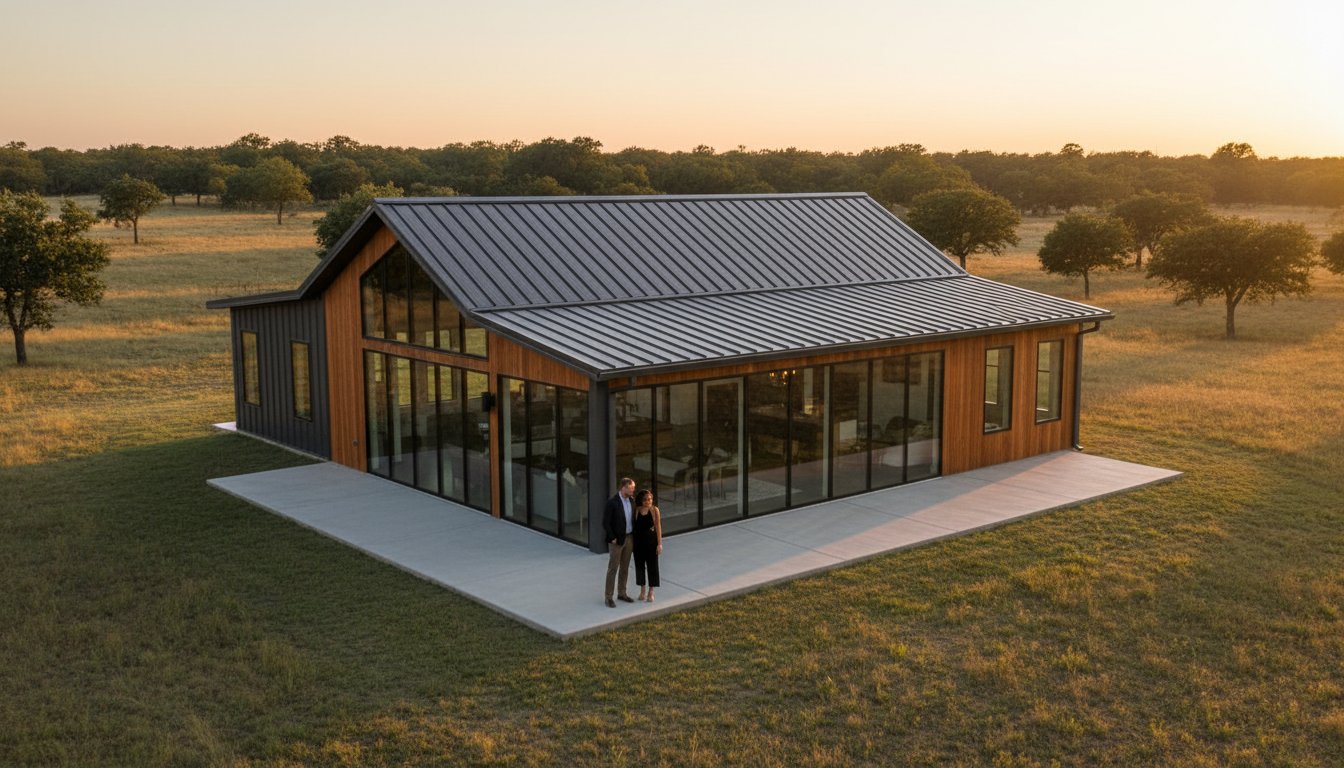
Not all metal building homes are the same thing. There’s a wide gap between a pre-engineered kit and a custom-designed steel residence, and most of what you’ll find online doesn’t make that distinction clear. This article does.
This article covers what custom metal building homes actually cost in Corsicana, how they’re built, what the soil and weather here demand from a structure, and what questions you should be asking any builder before you commit to a single dollar.
Table of Contents
What Metal Building Homes Are — and What They’re Not
There are two very different things being sold under the same name.
The first is a kit. A manufacturer ships you a package of pre-engineered steel components — columns, purlins, girts, roof panels — sized to standard dimensions. You or a contractor assemble them. The design is fixed before anyone looks at your land. Kits are inexpensive to start. Their limitations show up after you’ve paid.
The second is a custom-engineered metal building home. It starts with your site, your floor plan, and a structural engineer who designs the frame around both. The dimensions, spans, and load requirements are calculated for your specific property. Nothing is predetermined.
Most of what you’ll find online blurs these two things together. They are not the same product, and they don’t produce the same result. When you talk to any builder, ask directly: are you selling a kit, or are you engineering a structure from scratch? The answer tells you most of what you need to know.
What Navarro County Soil Demands from Your Foundation
The Blackland Prairie clay running through Navarro County expands when it’s wet and contracts when it’s dry. The seasonal movement can shift a foundation several inches. This is not unusual for the region, but it has to be accounted for in the engineering — and many builders don’t do that work upfront.
In wood-frame construction, foundation movement shows up as cracked drywall, doors that stick in summer and gap in winter, and floor systems that develop soft spots over time. You’ve seen it in older homes across the county. It’s not age. It’s soil that was never properly addressed.
A steel frame handles differential settlement differently than wood. The structural continuity of a welded or bolted steel frame distributes load more evenly and tolerates minor movement without the same visible damage. But the frame alone isn’t the answer — the foundation has to be designed for the specific conditions on your lot. That means soil borings, not assumptions. Any builder worth hiring will pull geotechnical data on your site before they design your slab.
Ask any builder you talk to: when do you conduct soil analysis, and how does that data inform the foundation design? If the answer is vague, keep asking.
How Metal Building Homes Hold Up in North Texas Weather
Steel doesn’t warp. It doesn’t rot. Termites have no interest in it. A properly maintained steel frame holds its structural integrity for decades without the maintenance cycles that wood requires.
On weather performance: a properly engineered metal building home is designed to exceed local wind-load codes, not just meet them. Standing seam metal roofs with Class 4 impact ratings handle North Texas hail significantly better than asphalt shingles. If you’ve filed a hail claim in Navarro County in the last five years, you know what that’s worth.
Fire resistance matters here too. Red iron structural steel is non-combustible. That affects both your family’s safety and what you pay for homeowners insurance annually. Get a quote before you build and compare it against what you’re currently carrying on a wood-frame structure.
The Insulation Reality for Metal Building Homes in East Texas
There’s a persistent belief that steel homes are uncomfortable — cold in winter, hot in summer, loud in rain. That belief comes from experience with uninsulated agricultural buildings. It doesn’t apply to a properly insulated residence, but the insulation has to be done right.
The system that performs best in this climate is closed-cell spray foam applied directly to the steel frame. It runs approximately R-7 per inch of thickness — roughly double the performance of standard fiberglass batt insulation. More importantly, it forms a continuous air and vapor barrier. In East Texas humidity, that vapor barrier matters as much as the R-value. Moisture infiltration into wall cavities is a long-term structural problem in wood-frame construction. Closed-cell foam prevents it in steel.
A 6-inch steel-framed wall finished with closed-cell spray foam reaches an effective R-value around R-38. A conventional 2×6 wood-frame wall with batt insulation typically achieves R-15 to R-19. That gap shows up in your utility bills every month.
Ask any builder you’re evaluating: what insulation system do you specify, and why? If they’re recommending batt insulation in a metal building home in this climate, that’s worth understanding before you proceed.
What Custom Metal Building Homes Cost in Corsicana
Custom metal building homes in Corsicana typically run between $175 and $250 per square foot, fully finished. Where you land in that range depends on floor plan complexity, exterior finish selections, and how you specify the interior.
A straightforward barndominium with an open floor plan, standard cabinetry, and mid-grade finishes lands toward the lower end. A home with custom millwork, high-end appliances, architectural steel details, and premium exterior cladding lands toward the upper end.
That range covers design, engineering, site prep, foundation, framing, envelope, mechanical, electrical, plumbing, and finishes. It does not cover land.
One thing to understand about how reputable design-build firms structure their pricing: the budget gets locked during pre-construction, before a shovel touches the ground. That pre-construction phase — the design work, engineering, soil analysis, and detailed cost estimating — has its own cost. It’s separate from the construction contract. The reason it exists is to produce a construction number you can rely on. Builders who skip that step and hand you a square-foot estimate are handing you a guess.
This rigorous pre-construction phase mirrors the due diligence process in commercial real estate, which is designed to protect significant investments. To see how professionals approach this, you can explore Property Condition Assessments (PCA).
Ask any builder: when does the price get finalized, and what work happens before that number is set?
How the Build Process Works for Metal Building Homes
The steel frame for a 3,000-square-foot residence can be erected in seven to ten working days. Conventional wood framing takes two to four weeks for the same footprint. That initial time savings compounds through the rest of the schedule.
From frame to turnkey, a design-build firm manages the full sequence: concrete, steel erection, roofing, envelope, mechanical, electrical, plumbing, insulation, drywall, and finish work. The quality of that coordination — who manages the trade partners, how conflicts in the schedule get resolved, how changes get documented — determines whether the timeline holds.
Before you hire anyone, ask to see how they handle project communication. A dedicated client portal with daily photo logs and current budget visibility is the standard you should expect from any firm doing this work. If a builder can’t tell you how you’ll track progress during construction, that’s a gap worth taking seriously.
The Questions Worth Asking Before You Build
Regardless of which builder you choose, these questions will tell you most of what you need to know.
-
Is this a kit or a custom-engineered structure?
-
When do you conduct soil analysis, and how does it affect the foundation design?
-
What insulation system do you specify, and why?
-
When does the price get finalized, and what work produces that number?
-
Can I talk to three people who built with you in the last 18 months?
That last question matters most. A builder’s references are the only independent verification you have. Call them. Ask specifically whether the final price matched what was agreed before construction started. The answer to that question is the whole story.
Trinity Metalworks builds custom metal building homes in Navarro County and across the Waco-to-DFW corridor. If you want a baseline cost estimate for your project, the barndominium cost calculator at trinity.pro is a reasonable starting point. When you’re ready to talk about your land and your budget, we’ll give you straight answers.
Every project is a promise kept.
Frequently Asked Questions
How much do metal building homes cost per square foot in Corsicana?
Between $175 and $250 per square foot, fully finished. That range reflects real differences in design complexity and interior specification. Any builder who gives you a single number before seeing your floor plan is estimating, not pricing.
Can I get a mortgage for a metal building home in Navarro County?
Yes. Texas lenders, including local credit unions and ag lenders like Texas Farm Credit, have established underwriting protocols for custom steel homes. You’ll need complete architectural drawings and a formal appraisal. The process is more straightforward than it was five years ago.
How does steel perform on Navarro County’s expansive clay soils?
Better than wood, when the foundation is engineered for it. The Blackland Prairie clay shifts seasonally with moisture. A foundation designed around geotechnical data from your specific site handles that movement. One built on assumptions doesn’t. Ask any builder when they pull soil borings and how that data changes the foundation design.
Are metal building homes louder in rain than wood-frame houses?
Not with proper insulation. The association comes from uninsulated metal barns. A closed-cell spray foam system applied to the steel frame dampens sound transmission significantly. Most owners report that their finished homes are quieter than expected.
How long does it take to build a custom metal home in Corsicana?
Steel framing goes up in seven to ten days. From groundbreak to keys, the total timeline is typically six to ten weeks shorter than a comparable wood-frame build, depending on scope and permitting timeline.
What is the difference between a kit and a custom-engineered metal building home?
A kit uses pre-manufactured components sized to standard dimensions. A custom-engineered home is designed from scratch around your site, your floor plan, and your local engineering requirements. The cost difference is real. So is the difference in what you end up with.
Does the foundation have to be different for a metal building home?
The foundation engineering should account for your frame type, your floor plan loads, and your soil conditions. In Navarro County specifically, the clay soil profile requires geotechnical analysis — not a standard slab template. Ask your builder how the foundation gets engineered and who stamps the drawings.
What insulation is best for a metal building home in East Texas humidity?
Closed-cell spray foam is the right answer for this climate. It delivers approximately R-7 per inch and — more importantly — forms a continuous vapor barrier that prevents condensation inside the wall cavities. In East Texas, moisture infiltration is a structural risk. Closed-cell foam eliminates it while delivering energy performance that batt insulation can’t match.
How much does a custom metal building home cost per square foot in Texas?
A custom metal building home in Texas costs between $175 and $250 per square foot. This range depends directly on your chosen finishes and design complexity. A simple floor plan with standard-grade materials will fall on the lower end. A bespoke home with luxury finishes, custom millwork, and high-end appliances will command a price at the top of that range. Our fixed-price contracts define this cost with precision before construction begins.
Can I get a traditional mortgage for a barndominium in Corsicana?
Yes, you can secure a traditional mortgage for a barndominium. Lenders in Corsicana and across Texas now widely recognize their value. Success requires a complete set of architectural plans and a formal appraisal. We find that local credit unions and specialized construction lenders offer the most streamlined approval processes, as they have specific experience underwriting these modern, efficient structures. They treat it just like any other custom home build.
Are steel frame homes louder than wood homes during rain or wind?
No, a modern steel home is not louder. That is a myth linked to uninsulated metal barns. With proper insulation, a steel home is exceptionally quiet. Applying 2 to 3 inches of closed-cell spray foam insulation dampens sound transmission by over 50 decibels, creating a serene interior that is often quieter than a comparable wood-frame house. The engineering of the building envelope ensures a silent, secure living space.
How long does it take to build a custom metal home compared to a stick-built house?
A custom metal home is built significantly faster. The core steel frame can be erected in just 5 to 7 days, while a traditional wood frame requires 2 to 4 weeks. This initial efficiency accelerates the entire project schedule. You can expect to reduce the total construction timeline by up to 30%, which often means moving into your new home 2 to 3 months sooner than with a conventional build.
What kind of maintenance is required for a steel building home?
Steel building homes require very little maintenance. The primary tasks include an annual gutter inspection and pressure washing the exterior siding every 3 to 5 years. Unlike wood, a steel frame is impervious to termites, rot, and warping, which eliminates the need for recurring pest treatments or structural repairs. This engineered durability saves thousands in upkeep costs over the home’s lifespan, providing a superior ownership experience.
Is a metal home safe from lightning strikes during Texas storms?
Yes, a metal home is exceptionally safe during a lightning strike. The steel frame functions as a Faraday cage, conducting the electrical charge around the exterior of the structure and harmlessly into the earth through the foundation’s grounding system. This principle, confirmed by the National Weather Service, prevents electricity from passing through the interior. Your family and electronics remain completely protected within the secure steel shell.
Can I customize the exterior of my metal home to look like a traditional house?
Absolutely. The exterior of your metal home can be finished to match any architectural style. We can apply traditional materials like brick veneer, stone wainscoting, Hardie board siding, or stucco directly to the steel structure. This design flexibility allows your home to integrate seamlessly into any established neighborhood or stand apart with a bespoke modern aesthetic. The underlying strength of steel empowers your design vision; it doesn’t limit it.


